
iFood
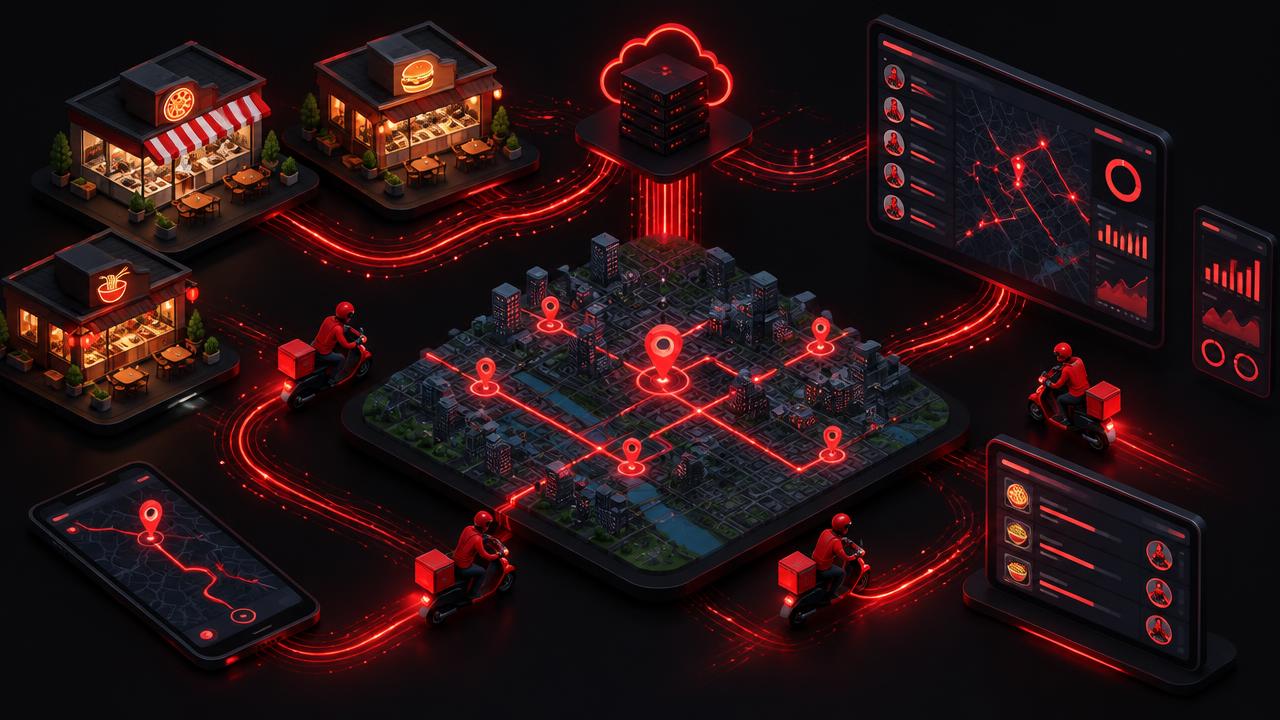
How iFood connects streaming events, a lakehouse, and machine learning to power food delivery.
Numbers that matter
The stack
The architecture as an interactive dashboard
The idea is simple: learn by reading the diagram. Every box and arrow tells part of the story — click to open.
Color signals the role: client, streaming, storage, compute, ML, serving. Click any box to see what it is, why it's used, and what happens there.
OptionalRead the full written deep diveThe same ideas as the diagram, with more context — recommended after exploring the steps.
Streaming events and orchestrated workflows solve different problems
Order and delivery updates matter to many consumers. Event streaming lets producers publish changes without owning every analytics or ML workload downstream.
Airflow orchestrates workflows; it is not the per-event transport. Separate continuous ingestion from scheduled recomputation, and define replay, deduplication and late-data policies explicitly.
The lakehouse as a reusable historical foundation
iFood's feature-store material connects Spark, Databricks and Delta tables: one durable history for processing, offline features and analysis, instead of separate extracts per consumer.
A newer Databricks case study reports 67% lower processing and storage costs and 70% less maintenance after moving pipelines to declarative pipelines — results of that initiative, not universal promises.
Features connect historical learning to live decisions
Documented ML uses include restaurant and dish recommendations, delivery-time estimation and courier allocation. A prediction is an input to a decision, not the whole decision system.
Treat freshness, entity keys and historical meaning as part of each feature's contract, so offline training and online serving agree.
Simulation complements production dispatch
The Databricks and Tableau story describes a simulator for testing business hypotheses before production changes — 10,000 simulations in a single month.
That loop differs from live courier assignment: simulation evaluates possible policies; operational services act on current conditions. Keep both connected without confusing them.
Curated sources
The public sources behind this analysis, with our take on why each one is worth your time.
Learn what makes this work
The DataForge courses that cover the pieces of this architecture.